
Hammonds Plains is named for Sir Andrew Hamond, a former governor of Nova Scotia. Upper Hammonds Plains was settled in 1815 by Black refugees from the Chesapeake Bay region who had come to Halifax after the War of 1812; each family received a ten-acre lot, and about 102 lots formed the original settlement of nearly 500 people (Hammonds Plains Historical Society, Wikipedia). The land they were given was rough, unworked interior land, with lumber nearby and access to the Bedford Basin.
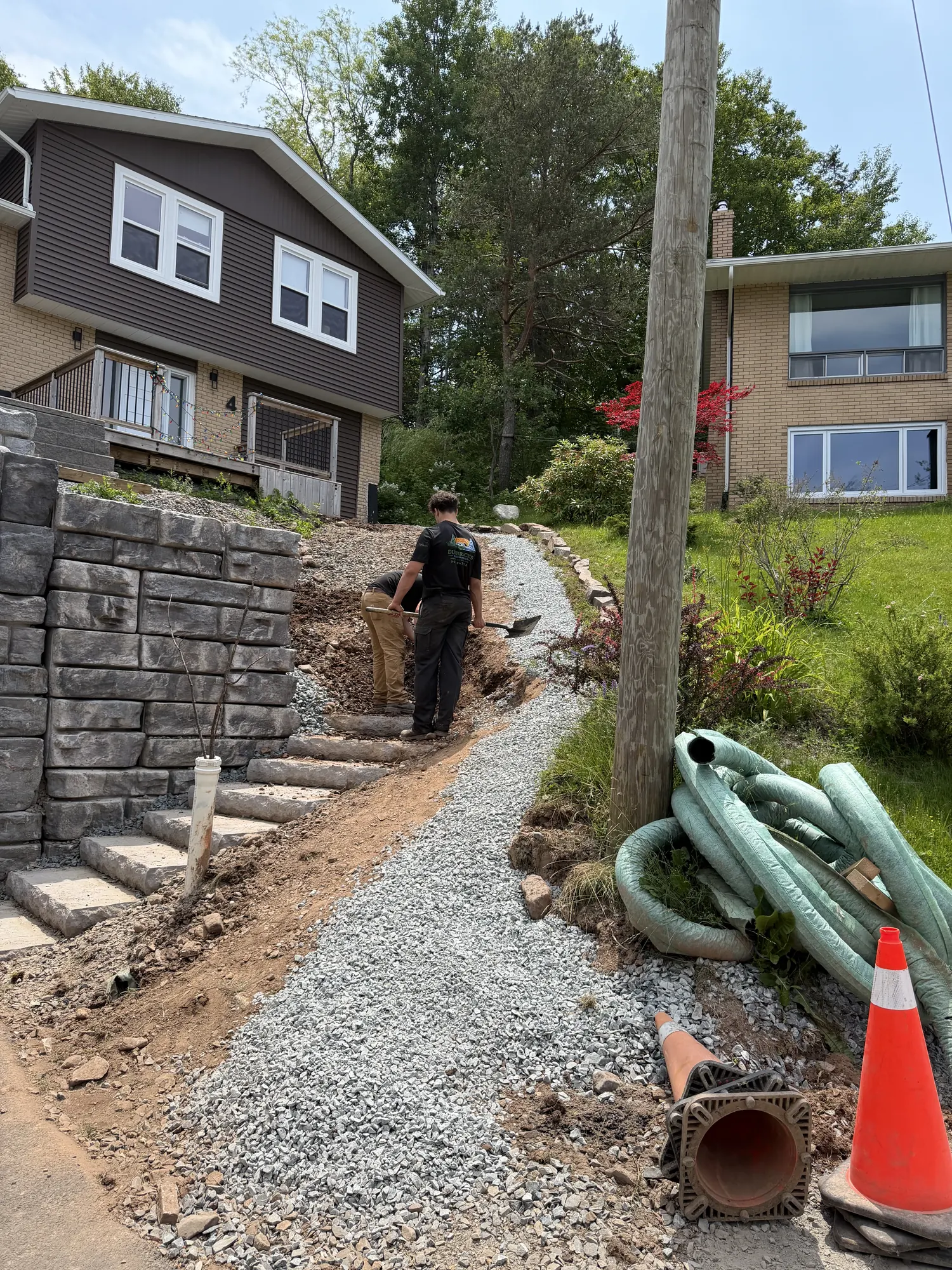
For homeowners today, that means larger lots, longer driveways and ground that can be rocky. This guide covers what to know before excavating, building a retaining wall or paving a driveway in Hammonds Plains.
Building on rock and till
The Halifax area’s bedrock is mainly Meguma slate and metasandstone, intruded in places by granite of the South Mountain Batholith, and covered by glacial till whose thickness varies (Nova Scotia Department of Natural Resources). In practice, that means rock can be close to the surface in places, so excavation, trenching and footings can take more time and equipment than a homeowner expects. A site visit before quoting is the honest way to scope that work.
Wells, septic and what is underground
Many larger lots outside the serviced core of the region rely on a private well and septic system rather than municipal water and sewer. Before any digging, find out where yours are. Utility locates cover buried lines: Halifax Water says requests go through Info-Excavation (1-866-344-5463) and are free, but a locate will not necessarily show a private septic field or well, so check your property records or ask the previous owner or installer.
Projects that suit larger lots
- Excavation and grading for new builds, pads, garages and drainage.
- Retaining walls to manage slopes and create usable level areas; anything over 1 m on a residential lot has extra requirements.
- Asphalt installation and driveways, including long approaches. Work that touches the street edge needs an HRM right-of-way permit.
- Drainage solutions to carry runoff away from buildings and driveways.
- Fencing, decks, pergolas and landscape lighting on larger, more exposed lots.
HRM rules worth knowing
- Retaining walls over 1 metre. Walls above 1 m on a residential lot require an engineer-designed, engineer-certified build and a Lot Grading Permit under By-law L-400, and nothing, footings included, may cross your property line. Source
- Driveway work at the street. Driveway, curb and culvert changes at the street edge need a right-of-way permit under the Streets By-law (S-300), and the by-law generally sets two-way residential driveway widths at 3–5 m where they reach the road. Source
- Floodplain rules near the Sackville rivers. HRM has been adopting floodplain maps and rules for the Sackville and Little Sackville rivers since 2023 (Bedford, Lower and Upper Sackville, Beaver Bank and Hammonds Plains); the interim rules restrict new development in 1-in-20-year flood-risk zones to uses such as recreation, forestry and fishing. Source
By-laws and permit rules get updated, so check the current version with HRM (halifax.ca or 311) before you commit to a design.
When to book
Search patterns across Nova Scotia (Google Trends) show interest in landscaping rising from March and peaking in May, with winter the quietest stretch. Excavation and retaining wall projects are best scoped in winter so permits, locates and engineering (where required) are finished before the ground is workable.
Services we offer in Hammonds Plains
Every project starts with a conversation and a free quote. We respond within 24 hours, and we’re available any day of the week.
Common questions
Do I need an engineer for a retaining wall in Hammonds Plains?
What should I do before excavating on a property with a well and septic?
Does Dunbrack’s serve Hammonds Plains?
Ready to plan your Hammonds Plains project?
Tell us about your property and we’ll get back to you within 24 hours with a free, no-obligation quote.
Sources
Facts about this area and the rules above come from these sources. By-laws, fees and permit requirements change, so confirm with the municipality before you start.
- History of Hammonds Plains — Hammonds Plains Historical Society
- Upper Hammonds Plains, Nova Scotia — Wikipedia
- Geology of the Halifax area (White et al., 2008) — Nova Scotia Department of Natural Resources
- Click before you dig — Halifax Water
- By-law L-400, Respecting Lot Grading — Halifax Regional Municipality
- Streets and Services permits — Halifax Regional Municipality
- HRM must implement Sackville rivers floodplain zoning, advocate says — CBC
- Google Trends: landscaping searches, Nova Scotia, past 5 years