
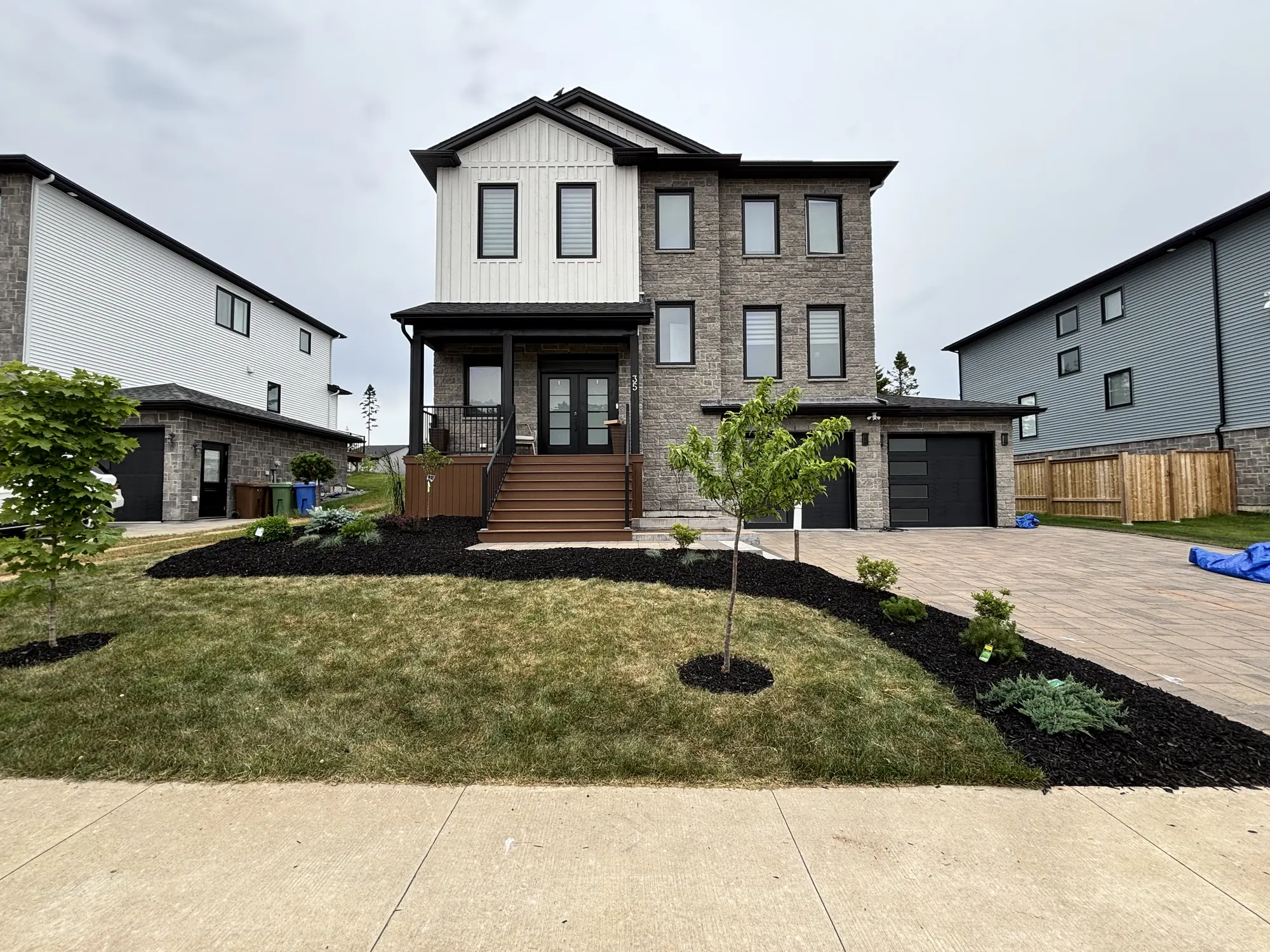
Bedford sits on the northwest shore of the Bedford Basin, where the Sackville River reaches salt water. It was its own town until 1996, when it joined Halifax, Dartmouth and Halifax County to form the Halifax Regional Municipality, and the 2021 census counted 36,354 people here (Wikipedia). It is also home base for Dunbrack’s Outdoor Services: owner Connor Amero is based in Bedford, so this guide comes from a neighbour’s point of view.
Most outdoor projects in Bedford come down to one question: where will the water go? Here is how the local landscape shapes landscaping and hardscaping, and what to check before you start.
Start with the water: Bedford’s river and lakes
The Sackville River is the main tributary of the Bedford Basin, and the area also holds Marsh Lake, Sandy Lake, Kearney Lake and Paper Mill Lake. The river has been heavily affected by development in its watershed and by a chronic loss of the natural vegetation along its banks, especially in downtown Bedford (Wikipedia).
In July 2023 a storm dropped more than 200 mm of rain across the Hammonds Plains, Bedford and Lower Sackville areas, much of it in five to seven hours (CBC). Reporting afterward noted that low-lying parts of Bedford, such as the Bedford Highway, Union Street, Bedford Place Mall and Range Park, often flood in heavy rain (CBC).
Since 2023 HRM has been bringing in floodplain maps and regulations for the Sackville and Little Sackville rivers, covering Bedford, Lower Sackville, Beaver Bank, Hammonds Plains and Upper Sackville. Under the interim rules, new development in areas at risk in a 1-in-20-year storm is limited to uses such as recreation, forestry and fishing. If your property is near the river or a lake, check HRM’s floodplain mapping before planning anything that changes the ground. We are landscapers and builders, not engineers, so for flood mitigation designs involve a professional engineer.
Drainage comes first
Halifax Water’s seasonal checklist advises homeowners to regrade so water drains at least 2 m (6 ft) from the foundation, run downspouts and sump discharge pipes out to the same distance, and fit a sewer backwater valve. Every patio, walkway and sodded area we build slopes away from the house, and grading is part of the plan, not an add-on. If water already pools near your foundation, a drainage fix usually comes before new hardscaping or sod.
Projects that suit Bedford yards
- Paver patios and walkways need a well-prepared, compacted base to stand up to freeze-thaw cycles and heavy rain.
- Retaining walls are common wherever a yard changes grade. Anything over 1 m on a residential lot has extra requirements (below).
- Decks need a permit and frost-protected footings; ask HRM whether a pergola or other structure on your lot needs one.
- Sod, plants and tree installations do best once drainage and grading are right.
- Low voltage landscape lighting brings out new beds and paths after dark.
- Fencing in chain link, wood or PVC for privacy and pets.
HRM rules worth knowing
- Retaining walls over 1 metre. On a residential lot, a wall taller than 1 m needs a Lot Grading Permit under HRM’s Lot Grading By-law (L-400). The by-law requires a professional engineer to design the wall and certify the build, and the wall and its footings must sit completely on your own property. Source
- Decks. New or replacement decks need a building permit. HRM’s deck FAQ requires footings with at least 4 ft (1.2 m) of frost protection when a deck is attached to the building or higher than 2 ft, and the site plan must show distances to property lines and any watercourse buffers. Source
- Underground utility locates. Before breaking ground, submit a locate request through Info-Excavation (1-866-344-5463 or the app), the service Halifax Water uses, which is free from Halifax Water. Source
Always double-check with the municipality (halifax.ca or 311); requirements and fees can change from one season to the next.
When to book
Google Trends data for Nova Scotia shows searches for landscaping climbing from March, peaking in May and staying above the winter baseline through August. If a patio, wall or deck is on your list, ask for a quote in winter so your project can start when the ground is ready.
Services we offer in Bedford
Every project starts with a conversation and a free quote. We respond within 24 hours, and we’re available any day of the week.
Common questions
Do I need a permit for a retaining wall in Bedford?
How do I find out if my Bedford property is in a floodplain?
Is Dunbrack’s based in Bedford?
Ready to plan your Bedford project?
Tell us about your property and we’ll get back to you within 24 hours with a free, no-obligation quote.
Sources
Facts about this area and the rules above come from these sources. By-laws, fees and permit requirements change, so confirm with the municipality before you start.
- Bedford, Nova Scotia — Wikipedia
- Sackville River — Wikipedia
- Nova Scotians describe harrowing encounters, damage from historic floods — CBC
- HRM must implement Sackville rivers floodplain zoning, advocate says — CBC
- History of flooding — Halifax Regional Municipality
- Seasonal checklist — Halifax Water
- By-law L-400, Respecting Lot Grading — Halifax Regional Municipality
- Decks: frequently asked questions — Halifax Regional Municipality
- Click before you dig — Halifax Water
- Google Trends: landscaping searches, Nova Scotia, past 5 years